Silicon carbide ceramics are highly regarded in the aerospace, semiconductor and new energy industries due to their outstanding high-temperature strength, excellent thermal conductivity and remarkable chemical stability. However, their extremely high covalent bond characteristics also make them one of the most difficult ceramic materials to sinter. To overcome this challenge, the industry has developed nine core sintering processes, forming a complete technical matrix.
Silicon carbide, as an important structural ceramic material, enjoys wide application in traditional industrial fields such as high-temperature kilnware, combustion nozzles, and heat exchangers due to its excellent high-temperature mechanical strength, high hardness, high elastic modulus, wear resistance, thermal conductivity, corrosion resistance, etc. It is also used in high-end applications such as bulletproof armor, space reflectors, and nuclear fuel cladding. The performance of silicon carbide ceramics is closely related to its sintering process. Through long-term research, various sintering techniques have been developed, including the early reaction sintering, atmospheric pressure sintering, recrystallization sintering, hot pressing sintering, hot isostatic pressing sintering, as well as new methods such as discharge plasma sintering, flash sintering, and oscillating pressure sintering that emerged in the past two decades.
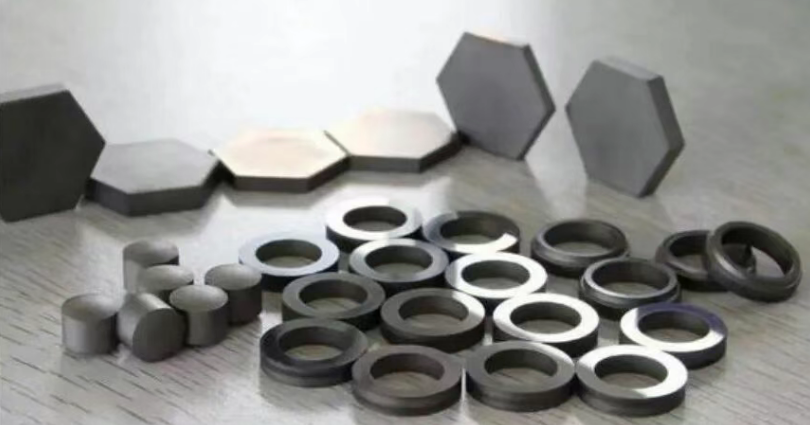
The process involves filling silicon carbide powder into a mold and applying pressure while heating to achieve simultaneous molding and sintering. The advantage of hot pressing sintering is that it can obtain dense materials under suitable pressure, temperature, and time conditions. However, its equipment is complex, the mold requirements are high, the process control is strict, and it is only suitable for the production of simple-shaped parts, with high energy consumption, low production efficiency, and high cost.
This process first mixes the carbon source with silicon carbide powder and forms a green body through injection molding, dry pressing, or cold isostatic pressing. Then, it is heated in a vacuum or inert atmosphere to over 1500°C to melt the solid silicon and infiltrate the pores of the green body. The liquid silicon or silicon vapor reacts with the carbon in the body, forming βSiC in situ and combining with the existing SiC particles to form dense reaction-sintered silicon carbide ceramics. The advantages are: low sintering temperature, low cost, high densification degree, and minimal volume shrinkage during the sintering process, making it suitable for the production of large-sized and complex-shaped components. Typical applications include high-temperature kilnware, radiation tubes, heat exchangers, and desulfurization nozzles.
- Atmospheric pressure sintering
This method achieves densification sintering of samples of different shapes and sizes within the range of 2000–2150°C by adding sintering aids without applying external pressure. The atmospheric pressure sintering of silicon carbide can be divided into two processes: solid-phase sintering and liquid-phase sintering.
- Recrystallization sintering
This process forms a green body by proportionally distributing SiC particles of different sizes and filling the gaps between the coarse particles. At a temperature above 2100°C and in a protective atmosphere, the fine particles evaporate and deposit at the contact points of the coarse particles, forming a "necking" structure between the particles, ultimately obtaining a sintered body with a certain porosity. The characteristics of recrystallized silicon carbide include: almost no volume shrinkage during the sintering process; the density does not increase significantly after sintering; the crystal boundaries are clean, without glass phase or impurities; the products usually contain 10%–20% residual porosity.
- Hot isostatic pressing sintering
This process uses high-pressure inert gas (such as argon) to promote material densification. The silicon carbide powder is sealed in a glass or metal sleeve, and a high static pressure of up to 200 MPa is applied at the sintering temperature to eliminate internal pores and achieve high density.
- Discharge plasma sintering
This is a rapid sintering technology that uses the high-temperature plasma generated by instantaneous discharge to activate the surface of the powder, removing the oxide film and adsorbed gases, and can complete densification at a lower temperature and shorter time.
Unlike traditional sintering, microwave sintering achieves overall heating by the dielectric loss of the material in the microwave field. Its advantages include low sintering temperature, fast heating speed, good material density, and the promotion of fine grain structure formation.
Flash sintering is an energy-saving and ultra-fast sintering method. During heating, a voltage is applied to the sample, and when the temperature reaches the threshold, the current nonlinearly increases, generating intense Joule heat, causing the sample to rapidly densify within seconds. Oscillating pressure helps to break particle agglomeration, promote particle rearrangement and plastic flow, increase the density of the green body and the sintering driving force. Especially in the later stage of sintering, it can effectively eliminate tiny pores at the grain boundaries, resulting in high-density, fine-grained, and highly reliable ceramic materials.
In industrial production, reaction sintering, atmospheric pressure sintering and recrystallization sintering are three commonly used methods for preparing silicon carbide, each with its own characteristics: Reaction sintering is suitable for manufacturing large-sized, complex-shaped components, and is often used in high-temperature kilns, flame nozzles, heat exchangers and optical reflectors. Atmospheric pressure sintering has a lower cost, and the product shape is not restricted. It has high density, uniform structure, and good comprehensive performance, and is mostly used for precision components such as seals, sliding bearings, bulletproof armor, optical reflectors and semiconductor fixtures. Recrystallization sintering silicon carbide has pure crystal phase, appropriate porosity, excellent thermal conductivity and thermal shock resistance, and is an ideal material for high-temperature kilns, heat exchangers and combustion nozzles.

